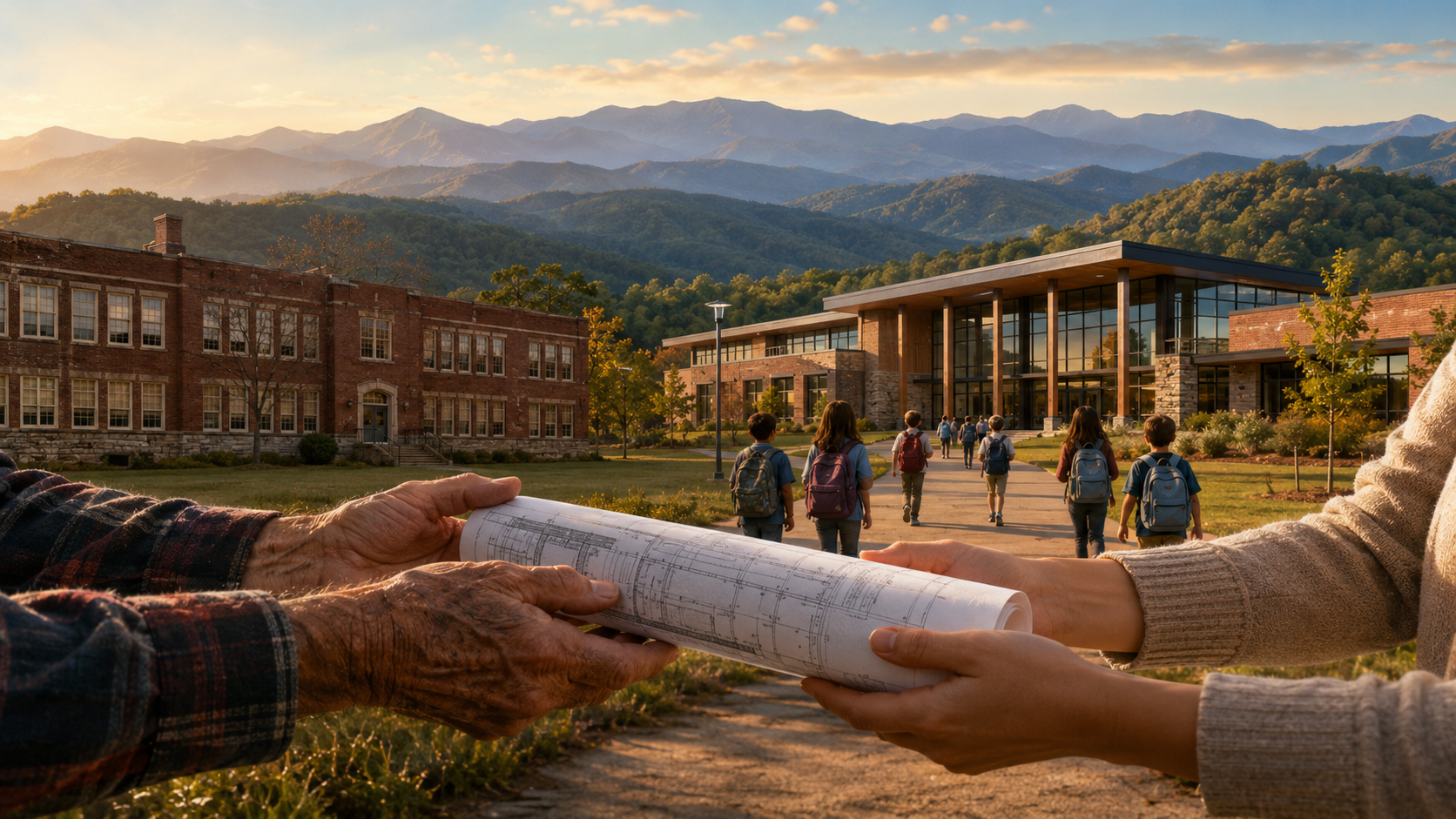
 Jackson County is not being asked to decide whether its public school facilities need work. Their ages, conditions and growing list of delayed projects have already answered that question.
The decision is whether the county will make a comprehensive investment now or continue repairing aging buildings one problem at a time while construction costs rise and additional needs accumulate.
Many of the facilities serving Jackson County students were built for another generation.
Jackson Community School dates to 1951. The school bus garage was constructed in 1957. The Smoky Mountain High School campus and the building now used as the school district’s central office were built in 1960. Fairview Elementary opened in 1973, followed by Blue Ridge School in 1975 and Smokey Mountain Elementary in 1980. Cullowhee Valley opened in 1994, while Scotts Creek was completed in 2001.
In 2026, that makes Jackson Community School approximately 75 years old, the bus garage 69, the Smoky Mountain High School campus and district office 66, Fairview 53, Blue Ridge 51 and Smokey Mountain Elementary 46.
Scotts Creek, now 25 years old, remains the newest conventional elementary campus constructed in Jackson County. Jackson County Early College received a building on Southwestern Community College’s campus in 2010, but the county has not built an entirely new traditional school campus in a quarter-century.
Those original schools did not appear without public investment. Previous generations used local tax dollars, state funding, borrowing and other public resources to build them. The same taxpayers later paid for new classrooms, kitchens, cafeterias, gymnasiums, bathrooms, security systems, athletic facilities and other renovations.
That history demonstrates an important point: constructing a school is not a one-time expense. A public school is a community asset that must be repaired, modernized and eventually replaced.
Blue Ridge School offers one of the clearest examples. Built in 1975 during a national recession and at the end of the Vietnam era, the school consolidated students from the Cashiers and Glenville communities. More than 50 years later, the campus remains an essential part of southern Jackson County.
Its facilities, however, no longer adequately serve the number and ages of students using them. The existing kitchen operates from a hallway beside the gym. During lunch, students waiting for food share the corridor with physical education classes and other students moving through the building.
The gym is in nearly constant use during the school day. It does not provide sufficient room for assemblies, graduations, athletic events and community gatherings, and accessibility remains limited.
The current capital plan calls for a new kitchen and cafeteria, a gymnasium, additional classroom space, site improvements and outdoor athletic facilities at Blue Ridge. These are not cosmetic changes. They are improvements intended to provide safe, functional spaces for instruction, meals, physical education and community activities.
Fairview Elementary opened in 1973 and has also required repeated renovations. Students have only recently begun moving away from a basement cafeteria arrangement. The county has allocated approximately $6.9 million for Fairview’s identified projects, meaning the school does not require an additional allocation from the proposed bond under the current plan.
At Smoky Mountain High School, the main campus dates to 1960, when it opened as Sylva-Webster High School. Smoky Mountain High was established in 1988 when Sylva-Webster and Cullowhee high schools consolidated at the existing campus.
Since then, Jackson County has added classrooms, renovated buildings and upgraded athletic facilities. Lights were only recently installed for baseball and softball, and the county is now working toward a sanctioned running track. Additional plans include field-event areas, stadium restrooms, accessibility improvements and a replacement fieldhouse.
The football stadium is not fully compliant with modern accessibility standards. Some restrooms have not been substantially updated in decades. These are facilities used not only by students but also by families and residents attending athletic events, graduations and other community activities.
The bus garage is even older. It was built in 1957, when school buses were shorter and transportation operations were considerably smaller. Modern buses do not fit efficiently inside the garage, leaving mechanics to perform some work outdoors in the heat, cold and rain.
The garage roof also leaks. Replacing that building would allow mechanics to service more buses at once, protect employees and equipment from the weather and provide suitable space for required driver training.
Other needs are spread throughout the district. Cullowhee Valley recently received new windows after the old ones became warped and difficult to close. The school still has accessibility, drainage and bathroom needs. Jackson Community School has needed HVAC and fire-alarm improvements. Roofs, windows and restrooms must be replaced or renovated at several campuses.
The district office occupies a building constructed in 1960 as Jackson County’s segregated school for Black students. It became the central school office following desegregation in 1965. Today, the building’s roof leaks, including near the server room that supports technology throughout the school system.
These problems cannot all be addressed through Jackson County Public Schools’ regular capital budget. Those annual funds are primarily used for preventive maintenance, technology, security and smaller improvements. They are not sufficient to build a new school or complete tens of millions of dollars in major renovations.
The centerpiece of the proposed investment is Smoky Mountain Middle School.
North Carolina middle schools began emerging during the 1960s as educators recognized that early adolescents benefit from a setting designed specifically for their academic, physical and social development. The most common school structure in North Carolina now separates students into elementary, middle and high school grade levels.
A central Jackson County middle school would bring students in grades six through eight together in an age-appropriate environment. It would also bring middle-grade teachers together, improving opportunities for joint planning, specialized instruction and coordination between subjects.
The school would provide adequate classroom space for core academics and expanded career and technical education. Students from different elementary schools could participate together in band, chorus, clubs and full-size athletic programs before advancing to Smoky Mountain High School.
That would make the middle school a true feeder program for the high school, allowing students and teachers to build programs over several years instead of starting over when students reach ninth grade.
The benefits would extend beyond the classroom. Students from different Jackson County communities already meet through recreation sports, churches, swimming, movies and high school athletic events. A middle school would give them a shared school community where they could study, compete, perform and socialize together.
Residents sometimes complain that young people have nothing to do in Jackson County. A modern middle school offering athletics, music, clubs, technical education and other structured activities would provide a direct answer to that concern.
The county has already committed $60 million toward the middle school, including a $52 million state grant and $8 million in local funding. The current estimated budget is approximately $108.6 million, leaving about $48.6 million to be provided through the proposed bond.
The proposed $105 million bond would complete funding for the middle school and provide money for Blue Ridge School, Smoky Mountain High School, a replacement bus garage and other facility needs and remodeling projects.
Proposed School Bond Breakdown
| School or project | Estimated project budget | Already allocated | Additional bond funding |
| Smoky Mountain High School | $10,962,187 | $2,618,044 | $8,344,143 |
| Fairview Elementary | $6,852,198 | $6,852,198 | $0 |
| Blue Ridge School | $38,835,000 | $15,000,000 | $23,835,000 |
| School Bus Garage | $5,803,000 | $0 | $5,803,000 |
| Smoky Mountain Middle School | $108,633,872 | $60,000,000 | $48,633,872 |
| Other facility needs and remodels | — | — | $18,383,985 |
| Total proposed bond funding | $105,000,000 |
The breakdown shows that approximately $86.6 million of the bond is connected to specific major projects. The remaining $18.4 million would be available for other needs and remodeling work across the district, including roofs, windows, restrooms and other facility improvements.
Blue Ridge School would receive the second-largest specific bond allocation at approximately $23.8 million. Combined with the $15 million already allocated, its total project budget would be approximately $38.8 million.
Smoky Mountain High School would receive approximately $8.3 million in additional funding, bringing its project budget to nearly $11 million. The replacement bus garage would receive approximately $5.8 million.
Nearly $48.7 million would be directed toward completing the middle school, accounting for the largest portion of the bond. That investment would build upon the $52 million state grant and $8 million local commitment the county has already secured.
The tax impact is significant but clearly defined. The county estimates an annual increase of $48.60 for every $100,000 in assessed property value. A property assessed at $300,000 would see an estimated increase of $145.80 per year.
Jackson County officials have described the county’s existing property tax rate as the second-lowest among North Carolina’s 100 counties. At the same time, the county’s official economic development information reports that outdoor recreation and tourism generate approximately $163 million in annual economic impact, ranking Jackson County 26th statewide in that category.
Jackson County has invested successfully in the natural attractions, recreational facilities and public services that make it an appealing place to visit. Its children deserve the same long-term attention.
The county must still complete its application to the North Carolina Local Government Commission. A public hearing is planned for Sept. 1, after which commissioners are expected to decide whether to place the bond referendum before voters in November.
The bond will not eliminate every maintenance problem, and the county will still have to budget for staffing, utilities and continuing upkeep. What it will do is provide the level of funding needed to address major projects that cannot be completed through routine annual appropriations.
One message circulating among supporters is deliberately blunt: “Invest in your kids. Drug dealers and vape stores are.”
The wording may be sharp, but the underlying point is difficult to dispute. Communities can invest in young people by providing safe schools, modern classrooms, technical education, athletics, music and structured activities—or they can pay later for the consequences of failing to provide those opportunities.
Previous generations built Jackson County’s schools even during recessions, political turmoil and periods of national uncertainty. They understood that educating children was not optional and that public facilities required public investment.
Those buildings have now served Jackson County for 50, 60 and even 75 years. The responsibility for preparing them for the next generation belongs to the community today.